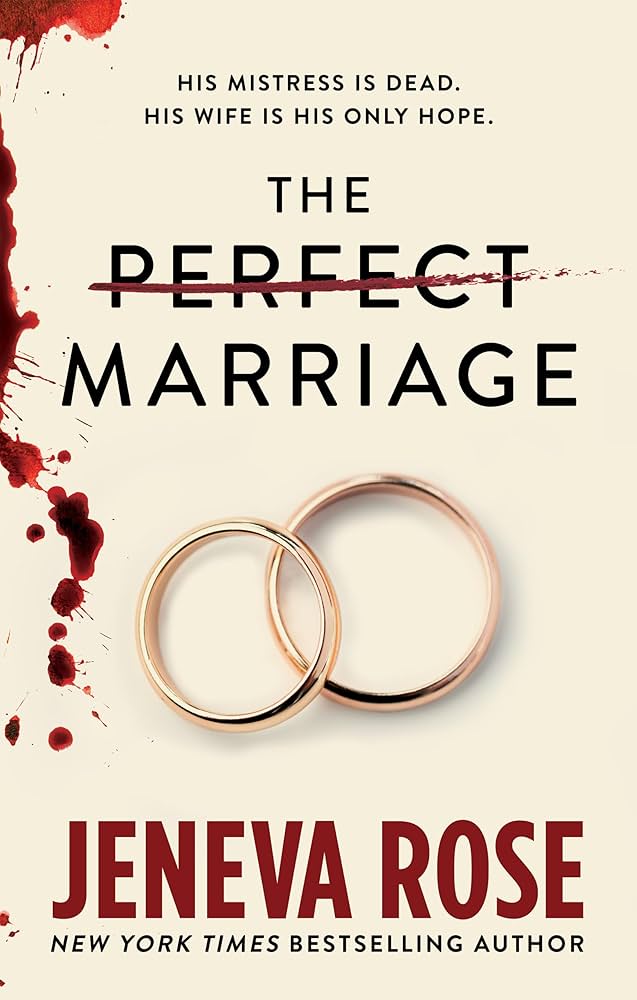
I hate this book.
I previously had zero plans to review it—in fact, I had planned on penning a comparison review of Frieda McFadden’s hit thriller The Housemaid and the recently released film adaption by the same name (what can I say, I’m a sucker for Amanda Seyfried and Sydney Sweeney).
But then, last Friday night, after almost three weeks of noncommittal listening to the Audible version of The Perfect Marriage, I reached the end.
And I. Was. PISSED.
So let’s get into it, shall we?
Summary
Published in 2020, The Perfect Marriage is the wildly successful debut novel of thriller author Jeneva Rose. If that name sounds familiar, you can blame BookTok: Rose is right up there with the likes of Frieda McFadden in terms of TikTok’s most beloved—and most controversial—psychological thriller writers.
As of July 2024, the book has sold over two million copies and has been translated into 27 languages, according to Rose’s Instagram. It also received a sequel, titled The Perfect Divorce, which released just last year in April 2025. The Perfect Marriage holds an average rating of 3.97 stars on Goodreads, and boasts over 1 million ratings and nearly 100,000 reviews.
The book follows the perspectives of Sarah Morgan, a high-powered defense attorney in Washington, D.C., and her husband, Adam, a struggling author whose career never quite came to fruition. Though they seem to have it all—a beautiful house, a loving marriage, even a lakeside getaway in Virginia—things aren’t quite as they appear. Sarah’s work consumes her life, leaving Adam resentful of both her success and what he perceives as Sarah’s neglect of their marriage. We also learn that, unbeknownst to Sarah, Adam has been cheating on her for the last two years with a local woman named Kelly, whom he plans to run away with.
That is, until Kelly is found stabbed to death in the Morgan’s lakehouse.
In an instant, Sarah’s life is turned upside down. Her husband is arrested and charged with murder as details of an affair she never knew about come to light in the most unexpected ways. Knowing she’s his only hope, Sarah steps up and takes on Adam’s case. But with Adam’s life at stake, and the line between truth and fiction blurred further with each new development, will Sarah’s expertise be enough to close the case and clear her husband’s name?
Disclaimer + Spoiler-Free Review
(As always, the latter part of this review will divulge spoilers. To accommodate readers who are looking for my general thoughts, I’ve included a spoiler-free section here. For those interested in my final verdict and rating for The Perfect Marriage, skip to the bottom of this post.)
This book failed in so many ways.
In my Goodreads review, I noted: “When will authors learn that having a first-person narrator outright LIE to your reader does NOT constitute a “thrilling twist”?”
And frankly, I stand by that 2000%.
I had my share of issues throughout this book, including characters whose arcs seem to go nowhere, details changing mid-narrative (a character’s eyes are said to be brown in one chapter, then blue several chapters later with zero narrative significance), and so many unbelievable approaches to the American justice system that my suspension of disbelief shattered less than halfway through.
But the real kicker, and the thing that made me want to throw a copy of this book out my damn window, was the twist.
Twists are essential to any thriller, I won’t deny that. But more and more these days, it feels as though authors (and the entertainment industry as a whole) are more focused on major “Gotcha!” moments that readers can’t see coming, rather than actually building up believable twists.
We saw it during Disney’s twist villain era of movies, from Frozen and Big Hero Six to Zootopia and Incredibles 2, where the villains suffered from poor writing in the form of either nonsensical motivations, zero build-up for audiences to follow, poor foreshadowing, or all of the above.
And now, regrettably, this awful trend has made its way into the thriller genre.
A good twist will catch readers off-guard, sure, but it shouldn’t feel completely out of left field. A reader, audience members, etc. should be able to review the material again at a later time and be able to pick up on clues or details they may have missed the first time that make the twist make sense. It also isn’t a bad thing if readers figure out your twist ahead of time because of these clues; instead, it often shows the twist is well-founded and makes sense within the narrative. It’s never worth sacrificing good quality storytelling just to shock your audience.
Unfortunately, that is exactly what we got here.
Terrible twists aside, these characters were infuriating to read, various arcs and storybeats went ultimately nowhere, and by the time the credits rolled on my audiobook, I felt worse overall for my experience than if I’d never read this book to begin with.
*Spoilers Ahead: You’ve Been Warned*
What Works
I’ll admit, I was interested in this book when I first started it. The concept is fascinating, if a little hard to believe: a woman must defend her cheating husband in court against a murder charge, where the consequence for failure is the death penalty.
(Even though Virginia—the state in which the book takes place—repealed the death penalty back in 2021…but, given this book was published a year prior, I’ll let it slide. Also, contrary to popular belief, it is perfectly legal—if not ethically questionable—for someone to defend their family member or spouse in court, even against murder charges. The more you know.)
I have to hand it to the Audible narrators, too, without whom I likely would never have finished this book. Rose’s writing is…fine, I guess, though I’ve found myself critiquing her style many times in other books of hers I’ve come across. However, listening to the narrators—both of whom give fantastic performances that truly embody their characters—really brought the story to life.
This is especially true for Adam’s section. Rose did a fair enough job of conveying an eloquent, if not overly prolific and borderline pretentious, written voice for Adam, but the character’s voice actor took it to new heights. Meanwhile, Sarah’s voice actor was the perfect contrast, sharp and logical, straight to the point and letting the listener know when she was absolutely done with the chaos surrounding her.
But L.K.! That’s just the audiobook. Why aren’t you focusing on the story itself?
I’m glad you asked. It’s because I firmly believe that, after finishing this story, there are simply no redeeming qualities in the book itself.
What Didn’t Work
Ohhhh boy. Grab a drink and take a seat, we’re in for a ride.
Where do I even begin with this? The flat characters? The red herrings that went nowhere? The lack of attention to detail that any competent author, let alone an editor should have been able to fix after a single round of revision?
Fuck it. Let’s start with the twist, and the clusterfuck that led up to it.
So Adam’s mistress is murdered, Adam’s arrested, and his wife Sarah needs to prove his innocence. Here are the facts:
- Adam’s mistress, Kelly, was married to a cop who allegedly abused her (we will get into this later)
- Kelly and Adam hooked up at Adam’s lakehouse the night she was murdered. Around midnight, Adam—not realizing Kelly was dead in bed next to him, SOMEHOW—left and made the hour plus drive back to D.C., finding Sarah in bed.
- The night of the murder, Sarah had gone out with her friend/assistant for drinks
- The morning after the murder, a maid found Kelly’s body
- Kelly was eight weeks pregnant with Adam’s child at the time of her death, unbeknownst to Adam, who has always wanted children (this is treated as important for half a second and then NEVER brought up again)
- After a shoddy investigation (which is an entirely separate shitshow), the sheriff’s department eagerly pins the crime on Adam, despite Kelly’s abuse allegations, three sets of DNA found inside Kelly, roofies found in alcohol at the scene, Kelly having an alias and a past history of alleged murder, Kelly having a stalker, the existence of countless other potential suspects, and the small issue of who the fuck leaves the body of someone they killed in their bed when they knew it would be discovered the next morning
So, yeah. To call this messy would be an understatement.
We learn that Kelly’s real name was Jenna, and that she had been previously charged in Wisconsin some years ago for allegedly murdering her husband. The charges were dropped after crucial evidence went missing, and she fled the state, changed her identity, and just so happened to marry one of the officers involved in the case, Scott, who became part of the same sheriff’s office now investigating his wife’s death.
Kelly told Adam previously that Scott was abusive to her, and there were bruises and malicious, threatening texts to prove it, but not only are these allegations never taken seriously, we also never get any closure about this. Adam flipflops between trusting Scott and blaming him for Kelly’s murder, and by the book’s end, Scott is written off as having fled the state.
Can I write off the mishandling of a cop’s involvement in a murder by a smalltown department as corruption or incompetence? Sure, for the sake of the story, and because, let’s be honest, it happens in real life, too. But there are too many coincidences, and too many failings in the investigation, to ignore. (Especially considering the defense attorney is supposedly one of the best in the region but we will get to that later.)
Two sets of DNA in Kelly are identified, belonging to her husband and to Adam. The third? Never identified until much, much later in the book, even though that’s a crucial piece of evidence. There are roofies found in a decanter of liquor, and in Kelly’s blood—but somehow not Adam’s, even though he drank from the same decanter. This clear lack of logic never comes up in the narrative until it’s convenient, and by that point, it’s too late anyway.
How about the other suspects? There’s Kelly’s stalker, who is a red herring. Oh, and Sarah’s assistant, who knew about the affair but didn’t want to hurt Sarah by saying anything. Oops, never mind, another red herring. Then there’s Sarah’s work rival, who was the brother of Kelly’s first husband—y’know, the one she allegedly killed. Nevermind, another red—
Oh. Wait. But more on that later.
Now, I’m no lawyer. But given every bizarre coincidence, every piece of evidence that, while circumstantial or inconclusive, could very well point to reasonable doubt—wouldn’t any competent defense attorney make a huge deal out of this?
SARAH DOESN’T. This hotshot defense attorney, who Rose goes out of her way numerous times to remind us made partner at her firm by thirty-two, who is absolutely the best of the best and no one can possibly rival her brains or wit or prestige or whatever—
Yeah, she does jack diddly squat.
The lead sheriff on Adam’s case admits to her that he’s unsure if Adam really did it, which makes sense. Who is so dumb as to leave a body where anyone can find it and link it back to you? Tack on her past, the other suspects, the unknown DNA, and you can’t convince me there isn’t room for reasonable doubt—which, fun fact, is the fucking LEGAL STANDARD for a not guilty verdict in the United States.
Sarah makes a big show of investigating possible leads—Kelly’s stalker, her first husband’s murder, the unknown DNA—but then never uses them to her advantage, simply shrugging them off as dead ends or just ignoring them.
This COMPLETELY goes against not only her job as Adam’s attorney, but also the basic role of the defense! All this evidence, while admittedly circumstantial, would be more than enough to at least plant the idea of reasonable doubt in the minds of a jury. And yet everyone acts like this case is some kind of slam dunk against Adam? It’s the further thing from!
The entire process reads like it was written by someone with zero understanding of how murder investigations and the legal system work. Hell, you could get more competent police work and court proceedings from an episode of Law & Order.
Oh, but there’s a reason for all of this. For you see, there’s the big, unexpected twist at the very end of the book.
The killer is none other than Sarah Morgan herself.
And now let me tell you why that makes NO FUCKING SENSE.
Liar, Liar, Book’s On Fire
This book is told in first-person, present tense. Both Sarah and Adam’s sections utilize this perspective, meaning that their stories are explained to us from their individual points of view as the events are unfolding.
At least, that’s how proper first-person perspective is supposed to work.
Sarah, for most of the book, is consistently emotionally affected by the events of the story as they happen. Her husband’s arrest, the news of his affair, her frustration at his antics as more evidence and questions mount. She genuinely seems in the dark about everything Adam was doing until it’s literally handed to her.
So, when we learn that Sarah knew about the affair all along and was behind not only Kelly’s death but framing Adam, it’s not a twist. It’s a downright lie.
Had Rose written this book in third person, prohibiting us from seeing into Sarah’s head and learning her thoughts and emotions, this twist might have worked. Hell, I’ll even be generous and say there were genuine moments where Rose made us question the kind of person Sarah really was.
We learn late in the book (Chapter 51 in a 64-chapter book) that Sarah’s mother became a drug addict following her father’s death, and died when Sarah was sixteen, with “four empty needles” in her arm. This immediately caught my attention. I’m not familiar with drug addiction or overdose, but even to me, that seemed excessive. Combined with Sarah’s thinly-veiled resentment and outright cruelty towards her mother, it made me question whether Sarah was responsible for her mother’s untimely end.
(The answer is yes, and is delivered in an unsatisfying final-chapter monologue where she reveals her entire nasty plan, but whatever. We’ll get to that in a moment.)
There’s also the fact that Sarah is repeatedly described as a cut-throat, high-powered attorney who defends some pretty screwed up clients (in one chapter, she’s defending a congressman against rape charges), which could lend itself to a vindictive, sinister character capable of pretending to defend her husband while leading him blindly to his execution.
BUT ROSE DOESN’T DO THAT!
Having us in Sarah’s head leads us to trust her because, again, we’re supposed to be learning information at the same time as Sarah is. She acts surprised by the events around her, so we believe that she truly knows nothing. But instead, it’s all an act. Sarah has been lying—but to who?
This is what pisses me off the most. Unreliable narrators are one thing. I love a story where the perspective of the narrator isn’t one we can really trust, because the events unfolding around them either favor them too much, or seem unrealistic and unbelievable, leading to a narrator who isn’t all there and thus, whose perspective colors the story in a way alternative to what’s actually happening.
But Sarah isn’t unreliable. She hides the truth until the final chapter, where she reveals it all via exposition dump, because God forbid we learn a character’s machinations organically instead of having everything spelled out to us.
My question is this: why? Why would Sarah lie to herself in her own thoughts?
Reveals like this do not work well with a first-person perspective because they break immersion. Is Sarah aware she’s a character telling a story to others, and thus is deliberately lying to the reader? If so, to what end? And if not (because there is no indication this is some kind of fourth-wall break directed at the audience) then why is she lying to herself?
It feels as though Rose is trying to pull off a Gone Girl kind of twist. However, this falls horribly flat considering we are in Sarah’s POV for about half the book from the very start.
Had Rose done what Gillian Flynn did and told the story primarily from the husband’s perspective, leading to a big reveal where we finally get a glimpse into Sarah’s head and see she’s behind everything, this twist might have worked.
But no. Rose, like other TikTok thriller darlings (looking at you, Frieda), opts to break the fourth wall and lie to readers in order to produce a decent twist. Ironically, in doing so, she ruins whatever hope she had of that twist being effective at all.
Loose Ends Left Hanging
Terrible twist implementation aside, this book has copious other flaws to rant about.
First, there’s the piss-poor investigation. There’s actually a reason behind it, which again we don’t learn until the final chapter, and even then, it’s handled so poorly that I’m having trouble believing Rose didn’t shoehorn this explanation in at the last minute.
Turns out that third set of DNA? It belongs to Sheriff Stevens, the lead investigator on Kelly’s murder and her husband’s boss/colleague. And this leads to far more questions than answers.
Why was he having an affair with Kelly? Why would he be so open to helping Sarah “discover the truth” when it could likely implicate him? Sure, you could argue he wanted to stay close to the defense attorney to glean info, in case his affair and thus involvement came to light—but that doesn’t make much sense, considering at no point does he ever try to derail or divert Sarah. He bounces between semi-flirting with her and stonewalling any questions she has, yet at the same time is willing to take her to the crime scene and go over case details with her?
Rose could’ve avoided this by simply making Stevens an uncooperative investigator. Sarah could have pointed out his shoddy investigative skills, only for him to double down and insist on Adam’s guilt. This would have perpetuated the small-town-police-corruption angle, and given both Sarah and the readers reason to suspect him of foul play, making Stevens a more legitimate red herring.
I mean, we still would’ve had no idea why he was sleeping with Kelly or what relevance that had to literally anything, but it would have been better than what we got.
Stephens screws up royally every step of the investigation. He claims they tested Adam’s blood for roofies and it came back negative, even though that’s literally impossible, since the decanter both Adam and Kelly drank from tested positive for roofies (courtesy of Sarah, of course). Sarah even acknowledges this in her final villain monologue, wondering how Stevens managed to screw up the testing so badly when both Adam and Kelly for sure had roofies in their system.
And another thing! Stevens never even considers that Sarah could be a legitimate suspect. Sure, she acted surprised about the affair, but how does no officer worth their salt look at a rich, successful woman whose husband is cheating and about to leave her (and talk half of everything she owns) and think, “Hmm. Maybe she has motive and is lying?”
Sarah chalks the entirety of Stephens’ poor police work up to him not wanting to implicate himself—but this rationale makes no sense when you think about it for more than a second.
It felt like Rose wanted to write a suspicious character who tries to both stonewall the investigation and also cozies up to those involved to keep tabs on any incriminating evidence. However, this doesn’t work when said character is the lead investigator on the murder. Pick a lane, Rose, because you clearly can’t do both.
Next, let’s talk about Sarah’s plan and how it came about.
Remember that business rival? The one who seemed like a red herring? Welp, turns out he was a double red herring.
Bob Miller, in an attempt to get back at Kelly for the murder of his brother—Kelly’s first husband—stalked her and found out about her affair with Adam Morgan. Bob attempts to blackmail Sarah with this info, hoping to ruin her career (somehow), but instead she…partners with him? The two agree to kill Kelly and blame Adam, taking their revenge against the people who wronged them.
Except Bob does literally nothing to contribute to this plan in the slightest. He’s out of town to establish an alibi, because of course the police would look at him before they look at the wife of the man whose mistress just got knifed.
So Sarah does the entire crime herself.
But remember: the night of the murder, she was out in D.C. having drinks with her friend/assistant, Anne. And remember: the drive from D.C. to the lakehouse is over an hour, as the narrative constantly reminds us.
Somehow, Sarah is able to escape from Anne, drive an hour into Virginia, kill Kelly, drive an hour back to the bar, and then get home in time to meet Adam. She leaves the bar around 10pm per her own accord, and the autopsy on Kelly puts her time of death between 11:30pm and 12:15am. Adam and Sarah both note that he got home around 2am, at which point Sarah was already half-asleep in bed.
So Sarah drove “over an hour” out of D.C., killed Kelly by 11:30pm, disposed of the murder weapon and her bloody clothes (and a tarp she admitted to using to shield Adam from the blood), got back into D.C. around an hour after that (so 12:45am the earliest, more likely 1am), and still left enough time to beat Adam home?
Is she fucking Superman? That is the tightest timeline I have ever seen.
Sarah’s assistant also confirms they were out in D.C. until after midnight, but Sarah acknowledges her assistant was too drunk to keep track of time—or of Sarah being gone for over two hours, apparently?
I’ve had my fair share of crazy nights. But unless you’re blackout drunk—and, seeing as Anne is at work the morning after, bright-eyed and bushy-tailed, I doubt she was that far gone—you do not lose hours of time, nor do you just blindly accept your friend being gone for that long without questioning a thing.
Sarah brushes this off since Anne idolizes her, and thus is certain she wouldn’t say anything even if she did remember the nights’ events—but is that not taking a huge chance?
Anne is interrogated at one point in the book, after it’s revealed she knew about Adam and Kelly’s affair, and she breaks down at the slightest bit of confrontation. Surely, surely the police would question Sarah’s alibi, even if they didn’t really consider her a suspect? Surely they’d question Anne, who falls apart at the slightest pressure, and realize Sarah’s alibi was shoddy at best? Surely they’d check the bar they visited at the very least, for due diligence?
You might say I’m not suspending my disbelief enough, but I’m calling bullshit. It’s a thriller with heavy police involvement. A few instances of incompetence, I can believe. But this much? And all to ensure that the main character gets away with literal murder? It’s not just unbelievable: it’s insulting to readers’ intelligence. If you’re going to write a murder thriller, you can’t just wave away every conceivable obstacle in your character’s way to make sure it goes right for them. It takes away the stakes and defeats the literal point of a thriller.
Other honorable mentions for why this book sucks include the lack of closure surrounding Kelly and Scott’s relationship—was he abusive to her, or was it an act?—and the truth about whether Kelly really did kill her first husband. There’s also a private investigator that Scott allegedly hired, only it turns out Sarah and Bob were behind it all, using her to spin Adam’s beliefs on the case and keep him off their tail. Except Adam mentioned the investigator’s name to Scott, and there was reference to someone allegedly stalking her, and none of that ever comes up again so why the hell did we spend so. Much. TIME ON IT?!
*screams into the void*
An Unsatisfactory End
Remember that scene in The Incredibles, where Syndrome makes fun of the fact that Mr. Incredible got him monologuing like a traditional supervillain? Remember how we used to make fun of bad guys sealing their fate by divulging their nefarious plans down to the letter, only to have it later end in their comeuppance?
Yeah, so, it seems like we’re regressing. I’ve lost count of thrillers where the twist is revealed not through careful storytelling and narrative brilliance, but through the villain telling us everything at the very end.
That’s not a twist. That’s an exposition dump with blood on it.
I’ll give Rose some credit: had her ending been done right, it might not have been entirely unbelievable. The pieces were there: Kelly’s vengeful brother-in-law seeking justice for his dead brother, a slighted wife seeking to punish her husband and his mistress for their affair, and the unlikely truce between two rivals who both stood to gain from joining forces.
But there’s nothing to piece it all together. Sarah tells us everything—her alliance with Bob, framing Adam, even killing her mother—in one giant revelation in the final damn chapter. There’s no evidence for the reader to pick up on that suggests she and Bob had a different relationship than we had been shown—he’s an asshole to her and we’re led to hate him in every chapter he’s in, right up until the last where she goes “Psych! We did it together and now we’re married too. Suck it!”
(Which pisses me off, too, because WHY WOULD YOU MARRY HIM?! You explicitly told us you hated each other! And to top it off, they have a daughter together named Summer—which was, in fact, Kelly’s surname. I hope this was some stupid coincidence because why would you name your daughter after your ex-husband’s mistress/your murder victim?!)
We already covered how Sarah’s perspective gives us next to no info about her involvement in the murder, aside from a few throw-away lines you could maybe read differently after learning the twist. But Bob? We’re led to believe his connection to Kelly is circumstantial at best, and he’s dismissed as a suspect before Sarah reveals he was behind it all along, too.
Again, not a twist. You just lied to us.
This book culminates not in any satisfying twist or grand reveal, but rather in a self-centered rant from Sarah about how smart she is, how much she wanted Adam to suffer, and how she got what she wanted in the end.
Maybe if this had been set up properly—and if Sarah wasn’t so fucking insufferable every time she was “on screen,” so to speak—it would have made for a sufficient conclusion. Instead, we’re left with the equivalent of some generic villain monologue that tries to be calculating, manipulative, and clever all at once, and fails spectacularly at all three.
L.K.’s Final Verdict
I have more I can say about this book. For once, I don’t want to.
Normally I like to end these sections with how I don’t think any book is really good or bad, and how taste is subjective. While I still hold true to that belief, I can’t bring myself to type it out here. Not for this book.
If you liked The Perfect Marriage, great. I’m sorry you’re reading a brutal dissection of a book you enjoyed.
Maybe I’m jaded from seeing the same thriller tropes get popular over and over again with very little thought put into paying them off. Maybe I’m annoyed at stupid twists that seem to come out of nowhere when that goes against the very nature of thrillers and whodunnit style novels. Or maybe I’m just pissed I wasted an Audible credit and my precious time on a book that did little but aggravate me when all was said and done.
Either way, I regret reading this book. Will I still read Jeneva Rose’s other books? Sure. I don’t want to believe an author is as bad as their worst book.
That said, I’m tempering my expectations considerably before going into any of her other works.
The Perfect Marriage gets 1 star out of 5, along with a request for thriller authors: please, for the love of all that is written and read: stop lying to readers under the pretense of a “good twist.” It does not work.
Until next time~
 Inkwells and Ivy
Leave a comment